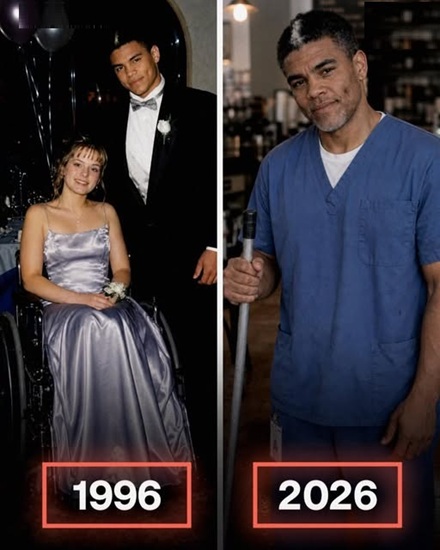
He asked if I was hiding.
I told him I wasn’t hiding if everyone could see me.
He didn’t argue. He just looked at me differently after that—less like someone trying to make conversation, and more like someone trying to understand.
Then he asked me to dance.
At first, I thought he was joking. So I told him I couldn’t. Not just because I was in a wheelchair, but because I genuinely didn’t understand what he was asking. He didn’t step back or laugh it off. Instead, he simply accepted the reality of the situation and said we would figure it out. That sentence changed the tone of the entire moment.
He wheeled me onto the dance floor without hesitation. I remember freezing, overwhelmed by the idea of being seen so openly. I told him people were staring. He told me they were already staring. There was no judgment in his voice—just honesty. Then he placed his hands gently on mine and began moving with me instead of around me.
It wasn’t a traditional dance. It couldn’t be. But it was still movement. Still connection. Still shared rhythm in a space where I had expected none. For the first time since the accident, I wasn’t being positioned as an exception or a limitation. I was simply part of the moment.
When the song ended, he returned me to my table as casually as he had taken me onto the floor. Before walking away, he said something simple: nobody else had asked.
After that night, life moved forward the way life does—without waiting for emotional meaning to catch up. My family relocated for ongoing medical care and rehabilitation, and Marcus and I lost contact. Not because of conflict, but because life divided us into separate paths that neither of us had the tools to reconnect.
My recovery took years. I learned how to adapt, how to move forward physically, and how to rebuild independence in a world not designed for people like me. Over time, I became an architect. Not because it was easy, but because I became obsessed with spaces—who they include, and who they quietly exclude without ever saying so directly. I built a career focused on accessibility and design that considered human experience beyond aesthetics.
Decades passed.
Then one ordinary afternoon, everything shifted again.
I was in a café near one of my project sites when I spilled coffee across the counter. A man working there came over immediately to help. He moved carefully, with a slight limp, and handled the situation without hesitation or judgment. Something about him felt familiar in a way I couldn’t immediately explain. When I looked at his face properly, I felt time collapse for a second.
He looked at me and said I seemed familiar.
I didn’t respond at first.
The next day, I returned.