“Yes.”
I wanted to believe him.
Trust had once come easily with Graham because he showed up in ordinary ways.
He packed my lunch when I worked late.
He kept jumper cables in my trunk.
He remembered how I took my coffee and always checked the weather before long drives.
Those small things had convinced me he was steady.
But steadiness only counts when the ground moves.
When his mother pushed me, Graham had chosen the version of peace that required my silence.
At two in the morning, my oxygen level dipped and the nurse adjusted my position.
Every movement hurt.
Graham stood to help, but I asked him not to touch me.
He sat down again.
That was the first boundary he respected without argument.
By morning, the bruising had spread across my side in dark bands.
Dr. Mercer explained that the lung bruising appeared stable, but I needed another night of observation and strict follow-up after discharge.
He also told me that rib injuries could worsen if I tried to rush recovery.
Graham asked whether he could take me home.
“No,” I said.
I called a coworker I trusted and asked whether I could stay in her spare room after discharge.
She did not ask for the polished version.
She only said, “I’ll be there.”
Graham heard the call.
He looked like he wanted to object, but he did not.
Later that morning, two relatives from Sunday dinner sent messages to the family group.
One wrote that she had seen Judith follow me toward the basement.
Another admitted the entire table heard Judith accuse me of turning Graham against her before the fall.
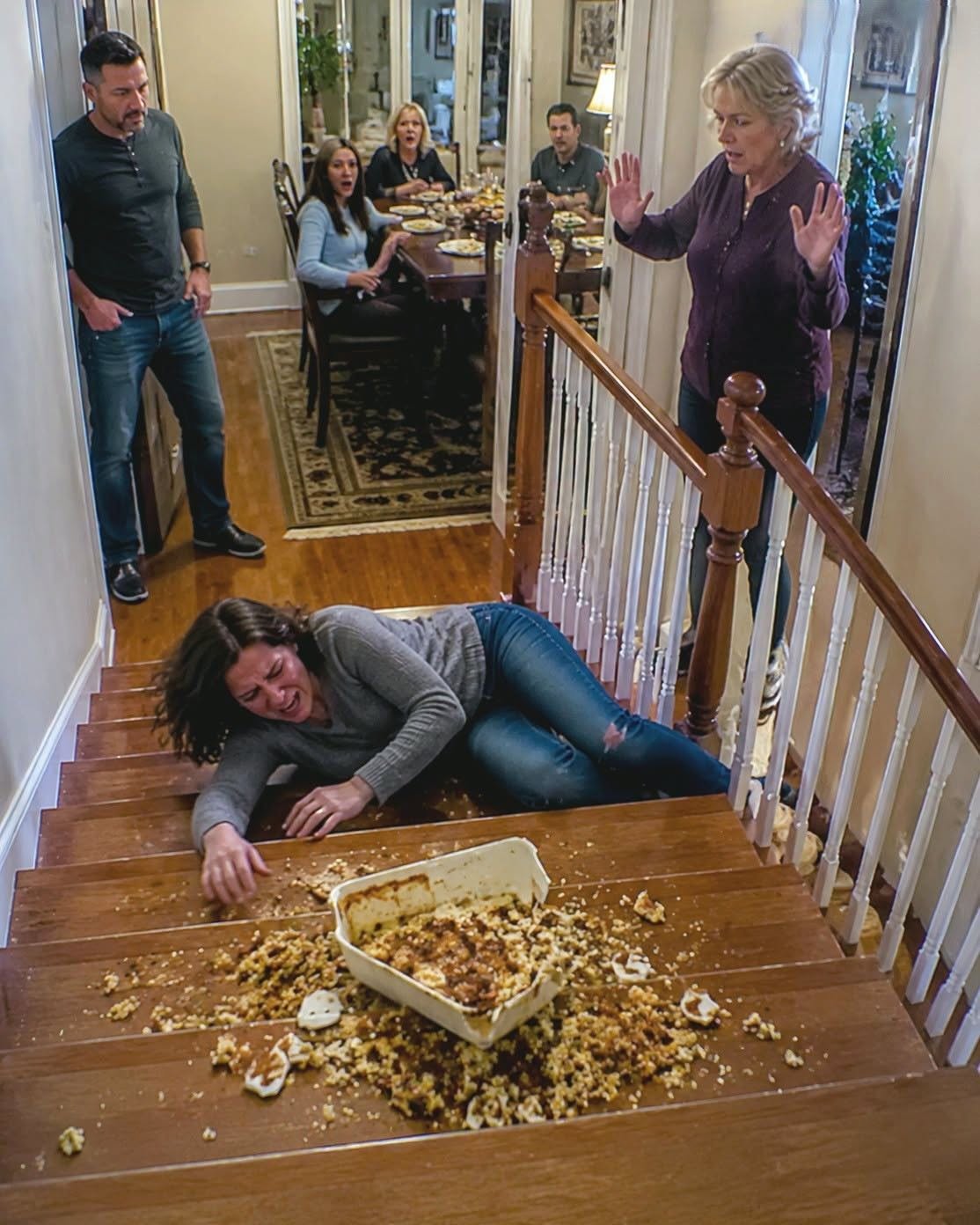
Neither had moved when I was lying on the concrete.
Now they were typing apologies from the safety of their own kitchens.
I was angry, but their messages mattered because they broke the agreement that Judith’s version would be the only version allowed to survive.
Graham added one more message.
I saw my mother put her hand on Nora’s back. Nora did not slip.
Judith responded within seconds.
She called him ungrateful.
She accused me of controlling him.
Then she left the group chat.
The family had spent years organizing itself around her reactions.
For once, the truth stayed in the room after she left it.
I remained in the hospital for another night.
Graham slept in a chair in the hallway because I would not let him back into my room.
He later told me he had nowhere else to go.
I told him that was not my problem to solve while breathing hurt.
When I was discharged, my coworker arrived with a paper coffee cup, a clean sweatshirt, and a pillow for the seat belt.
Graham stood near the exit holding my overnight bag.
He handed it to her instead of trying to carry it to his car.
“I am sorry,” he said.
“I know.”
It was not forgiveness.
It was only an acknowledgment that I had heard him.
For the next six weeks, my life became a schedule of medication, shallow walks, follow-up appointments, and sleeping upright because lying flat felt like being folded around broken glass.
My coworker left groceries outside the spare room and never made me explain why I cried when I heard footsteps behind me on the stairs.
Graham moved into a short-term rental.
He sent messages, but I answered only the practical ones.
He paid the medical bills that insurance did not cover.
He also gave a formal statement consistent with what he had finally said in the hospital.
Judith tried to contact me through relatives.
She called the fall an accident, then a misunderstanding, then a private family matter.
Each version asked me to carry the same burden: protect her from what she had done.
I stopped responding.
The case moved slowly through interviews and records rather than one dramatic confrontation.
My medical chart documented the fractures, lung bruising, pressure mark, and the account I gave before anyone could coordinate a story.
Read more by clicking the (NEXT »») button below!