Over time, a single coin could carry dozens of such stamps, each one representing another successful transaction.
When paper currency eventually replaced much of the metal coinage, the habit didn’t disappear. It simply adapted. Ink replaced metal stamps, but the meaning stayed the same.
What the Symbols Can Look Like
Chop marks don’t follow a universal design. They vary widely depending on who applied them and where.
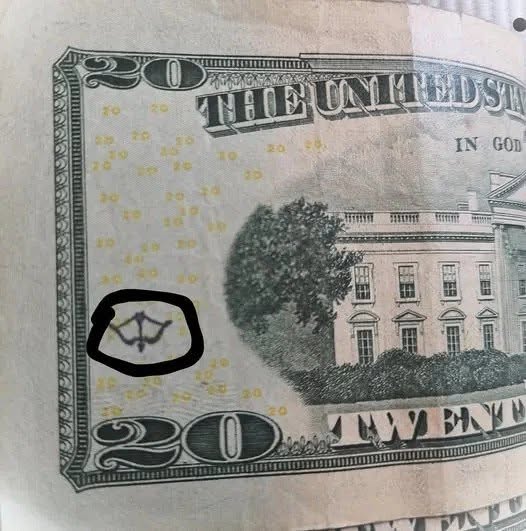
Some look like arrows, triangles, or abstract shapes.
Others include initials, numbers, or symbols from local writing systems.
Some are bold and dark. Others are faint and almost invisible unless you look closely.
Most are placed in areas that don’t interfere with important features of the bill, such as portraits or serial numbers. Experienced currency handlers know where to stamp without making the bill unusable.
To the untrained eye, these marks may look messy or strange. To those who understand them, they’re meaningful signals.
Practical Benefits in Everyday Trade
In modern markets where chop marks are common, they serve several practical purposes.
First, they reduce disputes. If a bill already carries marks from respected traders, fewer questions are asked. Transactions move faster.
Second, they build confidence in cash-based economies. When people rely on physical money rather than digital systems, trust must be visible.
Third, they help compensate for limited technology. Not every market has access to counterfeit-detection machines. Human inspection, followed by a mark, becomes the safeguard.
Ironically, in these environments, a bill with multiple chop marks may be considered safer than a perfectly clean one. Clean bills raise suspicion. Marked bills tell a story of survival.Ironically, in these environments, a bill with multiple chop marks may be considered safer than a perfectly clean one. Clean bills raise suspicion. Marked bills tell a story of survival.
Are Marked Bills Still Legal in the United States?
This is a common concern, especially among Americans who encounter a stamped bill for the first time.
In most cases, lightly marked U.S. dollar bills are still legal tender. They can be spent, deposited, or exchanged without issue.
However, heavily marked, torn, or damaged bills may be rejected by vending machines, automated counters, or banks that rely on strict standards.
That said, rejection by a machine doesn’t mean the bill has lost its value. Banks can often exchange damaged currency, and marked bills frequently continue circulating in local markets where personal trust outweighs mechanical approval.
Why Collectors and Historians Love Chop Marks
To collectors, chop-marked bills are far more than damaged currency.
They are artifacts.
Each stamp adds a layer of history. The shape, ink color, and placement can sometimes reveal where the bill traveled and who may have used it. A bill stamped in Southeast Asia may look very different from one marked in West Africa or Central America.
For historians, these marks offer tangible proof of global trade patterns, migration, and economic adaptation. They show how money connects people across borders long before digital systems existed.
For everyday people, they serve as a reminder that money isn’t just paper. It’s a witness.
A Dollar Bill as a Travel Journal
Imagine a single dollar bill.
Printed in the United States.
Carried overseas by a traveler.
Used in a street market.
Stamped by a shopkeeper.
Passed through dozens of hands.
Crossed borders again.
Each chop mark becomes a chapter in that journey.
By the time the bill finds its way back to someone’s wallet, it may have quietly touched more lives than we can imagine.
The Deeper Meaning Behind the Ink
At their core, chop marks are not about defacing money. They are about cooperation.
They represent trust built without contracts. Verification achieved without shared language. Agreement formed without formal institutions.
They show how humans adapt systems to meet real needs, especially in uncertain environments.
In a world increasingly dominated by digital transactions, these small ink marks remind us of something fundamental: money has always been about relationships.
Why These Symbols Still Matter Today
Even as cashless payments grow, chop marks persist because they serve a purpose technology hasn’t fully replaced everywhere.
They speak to resilience.
They speak to ingenuity.
They speak to the enduring need for trust in exchange.
So the next time you notice an odd stamp or arrow-like symbol on a dollar bill, pause before dismissing it as damage.
You may be holding a quiet piece of global history—one that has already proven its worth many times over.
Read more by clicking the (NEXT »») button below!