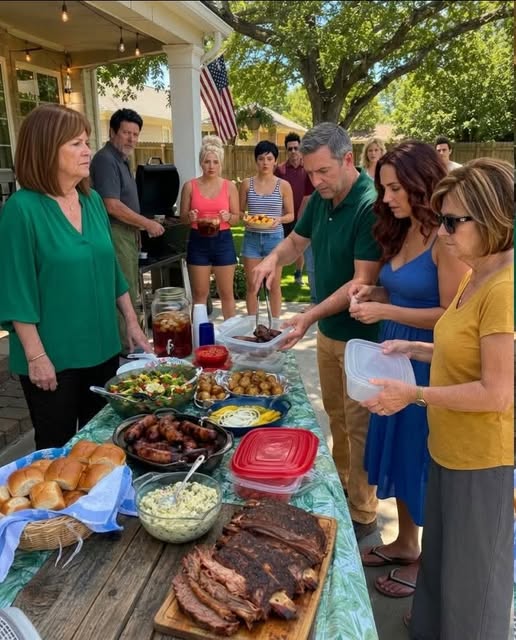
PART 1 — THE CONTAINERS
I spent $250 on thirty-three pounds of beef for our Sunday family barbecue.
Thirty-three pounds may sound excessive for eight people, but no one had ever left my home hungry. That was one of the rules I had lived by for years.
Whenever family walked through my front door, they received a full plate, a cold drink, a comfortable chair, and enough leftovers to remind them they were loved.
At least, that was what family gatherings used to mean to me.
I never expected my daughter-in-law, Rachel, and her mother, Stella, to arrive empty-handed with bags full of plastic containers, treating my backyard like a free restaurant.
And I certainly never imagined my own son, Julian, would help them pack up the expensive food I had prepared without asking my permission.
But that was exactly what happened.
When I finally spoke, three simple words silenced the entire patio.
My name is Betty Miller. I am sixty-five years old, married to my husband, Tom, and for most of my adult life, I had been proud to host every family gathering.
Our home stood in a quiet neighborhood outside Fort Worth, Texas. It was the kind of place where neighbors watered their lawns before the summer heat arrived, hung small flags near their porches, and waved at passing cars even when they did not recognize the driver.
Our backyard was not luxurious.
It had a brick patio, a large wooden table, a pecan tree that provided shade, and a grill Tom had cared for like a treasured family heirloom for nearly twenty years.
That yard had hosted birthdays, graduations, holiday cookouts, Easter egg hunts, and more Sunday meals than I could remember.
I loved hearing laughter beneath the tree.
I loved watching people carry plates from the kitchen.
I loved hearing the screen door open and close while someone asked whether there was more potato salad.
Tom often told me I had a gift for making people feel cared for.
Maybe I did.
Or perhaps I had simply spent too many years believing love meant doing more than everyone else while pretending not to notice when they gave nothing in return.
The Saturday before the barbecue, I woke before seven and sat at the kitchen table with a cup of coffee and my small planning notebook.
Tom sat across from me reading the local newspaper while I listed everything I intended to serve.
Brisket.
Beef ribs.
Skirt steak.
Sausages.
Roasted potatoes.
Garden salad.
Tomatoes.
Grilled onions.
Bread and provolone.
Iced tea, lemonade, and peach cobbler.
Tom lowered his newspaper.
“Betty, how many people are you feeding? The entire Dallas Cowboys roster?”
“There will only be eight of us.”
“Then why does that list look like you’re opening a restaurant?”
“There will be leftovers.”
“There are always leftovers.”
“That is the point.”
He shook his head, though he was smiling.
After thirty-nine years of marriage, Tom knew there was little value in arguing once I had decided to feed the family.
Around noon, I drove to Davis Market.
The Texas heat shimmered over the parking lot. Mr. Davis stood behind the butcher counter, as he had for as long as I could remember.
“What are we preparing today, Mrs. Miller?”
“A family barbecue.”
He smiled.
“Then I’d better bring out the good cuts.”
He selected brisket with a generous fat layer, meaty ribs, well-marbled skirt steak, and several thick steaks for Tom to grill and slice.
When everything was placed on the scale, the total came to thirty-three pounds.
“Big crowd?” Mr. Davis asked.
“Not really. Just family.”
He gave me a knowing smile.
“Sometimes family eats more than a crowd.”
I laughed, thinking he meant it affectionately.
Later, I understood that his words carried another meaning.
I paid $250 and loaded the bags into my car.
Julian was my only child.
He was thirty-two, hardworking, intelligent, and once very thoughtful. As a boy, he used to help set the table without being asked.
Then he married Rachel.
I did not believe she transformed him overnight. Life was rarely that simple.
But gradually, my son became quieter around her.
He watched her expression before answering questions.
He canceled plans when she did not want to attend.
Whenever she made a sharp remark, Julian laughed nervously, hoping everyone would ignore it.
But I noticed.
A mother usually does.
Rachel was beautiful in a carefully polished way. Her hair was always smooth, her nails immaculate, and her perfume expensive.
Her smile appeared warm in photographs, but rarely reached her eyes.
Her mother, Stella, was sixty, divorced, and extremely proud of being “particular.”
That was Rachel’s preferred description.
In my experience, “particular” meant Stella criticized everything while expecting people to praise her honesty.
Still, I continued inviting her.
I told myself she lived alone.
I told myself perhaps she needed a family.
That was one of my oldest mistakes.
I repeatedly confused generosity with silence.
On Saturday afternoon, I called Julian to confirm the plans.
Read more by clicking the (NEXT »») button below!