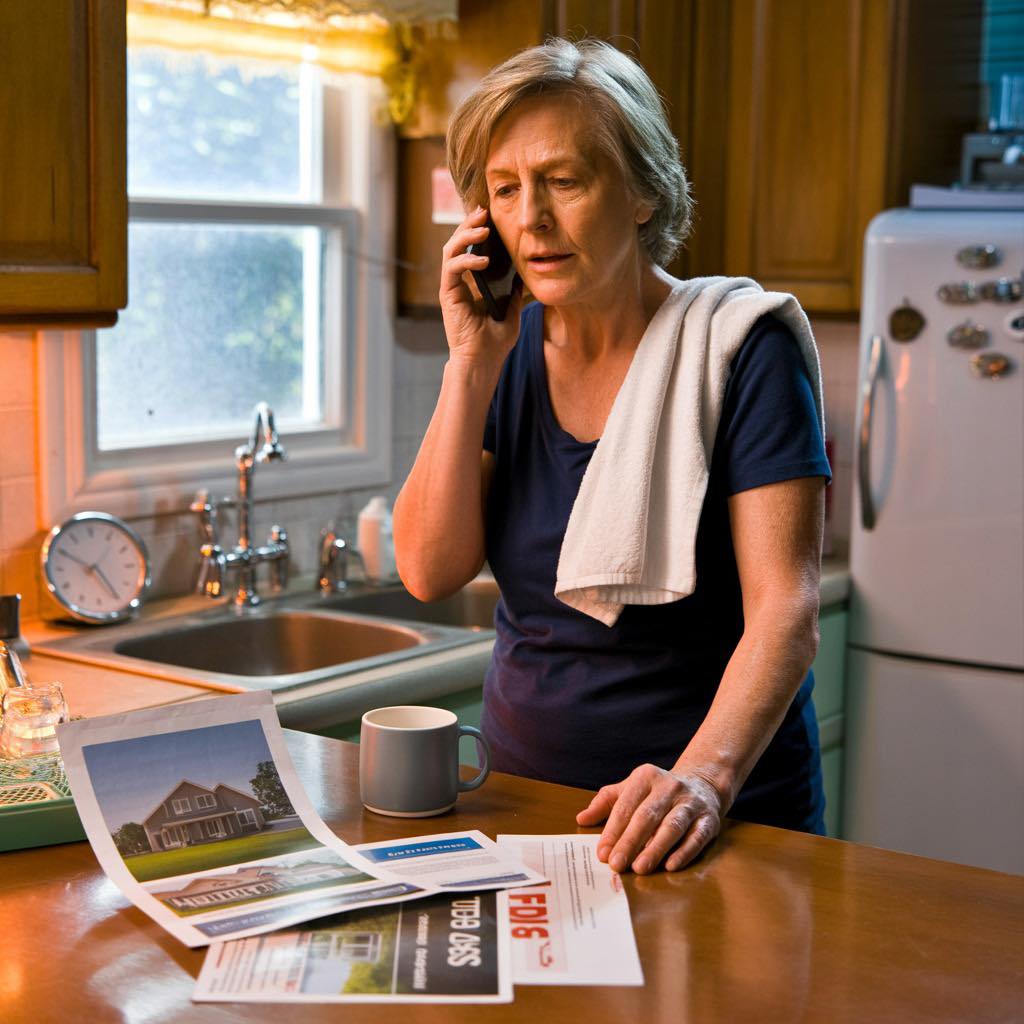
My daughter shoved me to the floor of the house I’d bought for her, left me bleeding on the hardwood I’d helped install, and screamed at me to get out. Five hours later, after I’d canceled the mortgage payments and called my realtor, my phone lit up with thirty missed calls. But I’m getting ahead of myself. Let me tell you how a mother learns that sometimes the people who hurt you most are the ones you’ve sacrificed everything for.
My name is Elena Patterson, and at fifty-eight years old, I thought I understood what family meant. I thought I knew the difference between supporting your children and enabling them to treat you like an ATM machine with unconditional love programmed into its circuit board. I was wrong about so many things, but I was absolutely right about one thing: there comes a moment when you have to choose between your child’s comfort and your own survival, and that choice will define the rest of your relationship.
The phone call came on a Tuesday morning in March, one of those deceptively beautiful spring days when the world pretends winter is finally over. I’d just finished my morning coffee—two sugars, splash of cream, the same way I’d been drinking it for forty years—and was reading the newspaper when my phone buzzed across the kitchen table. Sarah’s name flashed on the screen, and my heart did that little skip it always did when one of my children called, that involuntary flutter of maternal response that apparently doesn’t diminish even after twenty-eight years of parenting.
Sarah was my eldest at twenty-six, and she’d been living in the house I’d purchased for her family three years ago. Not renting—living. I’d bought the four-bedroom colonial in Maple Heights outright, put it in my name because her husband Mark’s credit was too damaged from his unemployment period to qualify for a mortgage, and I’d been making the monthly payments—$2,400 like clockwork—for thirty-six consecutive months. It wasn’t easy on a retired teacher’s pension, but what mother wouldn’t sacrifice for her daughter’s family?
The house was perfect for Sarah, Mark, and my two precious grandchildren: seven-year-old Jake with his gap-toothed grin and obsession with dinosaurs, and four-year-old Lily who still called me “Gamma” because she couldn’t quite get her tongue around the full word yet. White picket fence, excellent school district, safe neighborhood with tree-lined streets where children rode bikes without supervision. Everything I’d dreamed of providing but couldn’t afford when Sarah was growing up in our cramped two-bedroom apartment where the walls were so thin you could hear the neighbors’ television through the drywall.
I wanted better for Sarah. I wanted her children to have stability, to never worry about eviction notices or utility shut-offs or any of the financial anxieties that had plagued my own single-mother years after Sarah’s father walked out when she was three.
So when Sarah and Mark were struggling three years ago—Mark newly unemployed, Sarah overwhelmed with two small children and unable to work full-time—I’d stepped in without hesitation. I liquidated my modest retirement savings, took out a substantial loan against my own home, and made their dream of homeownership happen. Well, my dream for them, anyway.
“Mom? Can you come over?” Sarah’s voice on the phone sounded strained, tight with something I couldn’t quite identify. “We need to talk about something important.”
The words made my stomach clench with that particular maternal anxiety that never quite goes away no matter how old your children get. In my experience, conversations that began with “we need to talk” rarely ended with good news. But this was my daughter, my firstborn, the little girl who used to crawl into my bed during thunderstorms and tell me I was the bravest person in the world.
“Of course, sweetheart. Is everything all right? Are the kids okay?”
“Everyone’s fine,” she said quickly, too quickly, the words running together like she’d rehearsed them. “Just come over when you can. We’ll be here all day.”
I threw on my coat—the navy peacoat I’d owned for ten years because I couldn’t afford to replace it after making Sarah’s down payment—and drove the fifteen minutes to Maple Heights. My twelve-year-old Honda made a concerning rattling sound that I’d been ignoring for months because the repair estimate was more than I could spare. Meanwhile, Sarah and Mark both drove newer vehicles, purchased with money they’d saved by not having a mortgage payment. The irony wasn’t lost on me, but I’d chosen not to dwell on it. That’s what mothers do, right? We make sacrifices without keeping score.
The house looked beautiful when I pulled into the driveway, exactly like something from a home-and-garden magazine. The lawn was immaculate thanks to the professional landscaping service I also paid for—another $200 monthly expense I’d absorbed without complaint. The exterior had been freshly painted last spring in a warm cream color Sarah had chosen after showing me seventeen different samples. I’d written the check for that too, along with the new roof the previous winter when Sarah had called in a panic about water damage, and the kitchen appliance upgrade when she’d decided the existing refrigerator wasn’t large enough for their needs.
Adding it up in my head as I walked to the door, I realized I’d probably put close to $200,000 into this house over three years—money I’d never see again, money that should have been securing my own future. But that’s what you do for family, I’d told myself. You invest in their happiness.
I rang the doorbell even though Sarah had told me dozens of times I didn’t need to, that this was “basically my house too.” But it wasn’t, really. This was her home, her space, her family’s private domain, and I respected those boundaries even though my name was on the deed. Mark answered the door, and something in his expression immediately activated my internal warning system. He looked uncomfortable, couldn’t quite meet my eyes as he stepped aside to let me in. Mark was usually warm with me, grateful for everything I’d done, full of those awkward son-in-law pleasantries about how lucky they were to have me. Today he looked like a man who’d rather be anywhere else on Earth.
Sarah was sitting on the living room couch—part of the expensive furniture set I’d helped them purchase when they first moved in because they’d had nothing but a futon and some plastic lawn chairs. She looked nervous, her hands clasped tightly in her lap, knuckles white with tension. The children were conspicuously absent, which was unusual. Normally Jake and Lily would come running when I arrived, eager to show me their latest drawings or tell me excitedly about something that happened at preschool or school.
“Where are my grandbabies?” I asked, trying to lighten the heavy atmosphere with grandmotherly affection.
“Upstairs playing,” Sarah said shortly, not quite looking at me. “Mom, sit down. We need to discuss the house situation.”
The house situation. The phrase sent a chill down my spine, but I told myself to be optimistic. Maybe they were finally ready to take responsibility, to start making the payments themselves. Mark had been back at work for over a year now in a stable position. Maybe they’d gotten promotions. Maybe Sarah had decided to return to work part-time now that Lily was getting older and would start kindergarten soon. Maybe this conversation would be about them finally stepping up and taking ownership—literally and figuratively—of their own lives.
Read more by clicking the (NEXT »») button below!