Your name is Lucy Navarro, you are thirty-four years old, and by the time the doorbell rang at nine the next morning, you had already buried the version of yourself that still believed patience could save a marriage. You opened the door with your shoulders straight, your hands cold, and your heart so calm it almost frightened you. Elena Robles stepped in first with a red folder tucked beneath her arm, a notary behind her, and two uniformed officers standing at the end of the hall like punctuation marks at the end of a sentence you had finally decided to finish. Behind you, in the dining room, your husband was stirring his coffee as if the world still belonged to him.
His mother, Carmen Serrano, arrived almost at the same second, wearing a beige coat and the smug little smile she always used when she thought she was about to win. She had come for the envelope. She expected to sweep in, collect the cards and the cash, and leave with the satisfaction of a woman who had trained her son to kneel while another woman paid the rent. The moment she saw the notary and the officers, that smile faltered, but only for a heartbeat. Then she squared her jaw and stepped inside as if authority could still be claimed by posture alone.
Álvaro stood up too fast and sloshed coffee onto the table.
He looked from Elena to the officers to you, and at first he did what weak men always do when consequence enters the room. He tried to smile through it. He asked whether this was a joke, whether you had really invited strangers into your home over “a family misunderstanding,” whether you had any idea how ridiculous you were making yourself look. Elena did not answer him immediately. She placed the red folder on the table with a softness that somehow felt more threatening than a slam.
Then she started reading.
She informed him that the apartment was titled solely in your name, that the original purchase contract, the closing documents, and the gift letters from your parents made that unmistakably clear, and that he had signed an occupancy acknowledgment at the time of purchase stating he had no ownership claim. She informed him that all shared financial authorizations had been revoked at dawn, that the credit cards in the envelope were now canceled, and that any attempt to use them would trigger fraud alerts. She informed Carmen that she was not authorized to take possession of any financial instruments or cash belonging to you, and that the notary was present to witness an inventory of all marital property and personal documents before your husband was served with a formal notice to vacate.
You watched the blood drain from Álvaro’s face in layers.
Not because he suddenly understood the law. Men like him never do that quickly. It was because he finally understood that this was not another kitchen argument he could outwait. The officers were not there to arrest him, not yet, but they were there to ensure the morning did not turn into the kind of scene his mother always relied on when intimidation was her last remaining currency.
Carmen laughed first.
It was a brittle, contemptuous laugh, the kind women like her produce when reality starts slipping and they think volume can still pin it in place. She said that in America, married people shared everything. She said you were acting hysterical, vindictive, unstable. Then she made the mistake of pointing toward the envelope on the counter and telling Álvaro to “just take it and let these people leave.”
One of the officers turned toward the envelope before anyone else moved.
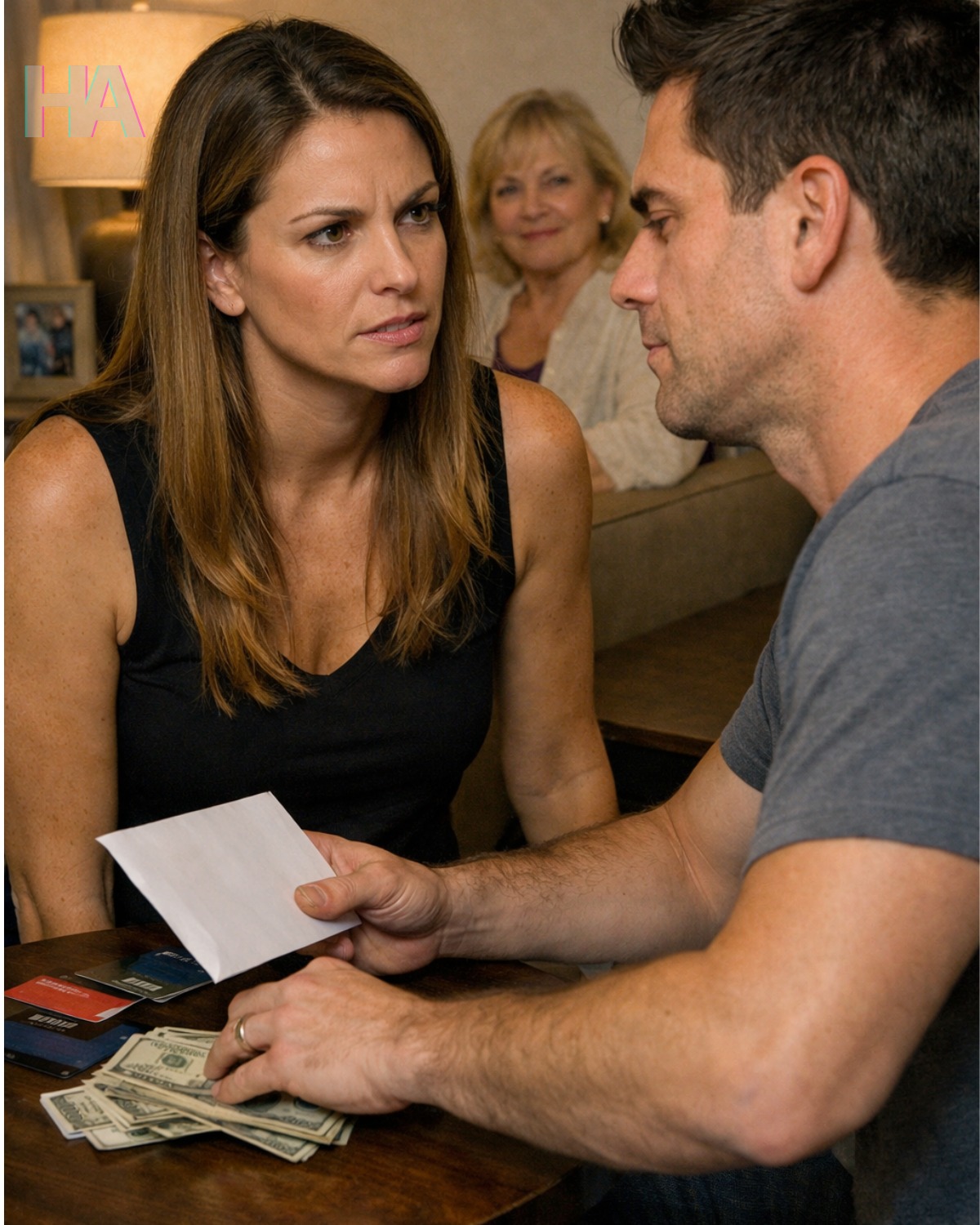
Elena asked, in the stillest voice in the room, whether the envelope contained cards tied to accounts now frozen, cash withdrawn from a residence not solely occupied by your husband, or identification documents not belonging to him. Álvaro did not answer. Carmen tried to answer for him, which was somehow worse. The officer asked him again, and this time he reached for the envelope like a teenager caught with something stolen, slow and uncertain, suddenly aware that the room was no longer arranged to protect his pride.
Inside were four canceled cards, $6,200 in cash, two checkbooks, and your passport.
For the first time that morning, silence hit the room hard enough to feel physical. You had not known about the passport. Neither, apparently, had Elena. Carmen opened her mouth, but nothing intelligent came out. Álvaro muttered something about keeping important things “safe,” and you saw Elena’s expression change by a single degree, which with her was the legal equivalent of a knife being unsheathed.
The notary began writing.
Elena informed both of them that removing your passport without your knowledge, along with joint cash and financial instruments, would now be added to the record. She explained that because there was already documented evidence of financial coercion, repeated demands for money, and unauthorized attempts to centralize control of household funds under Carmen’s direction, she had advised you to request a civil standby. The officers were not there because you were dramatic. They were there because the pattern was bad enough that your attorney preferred witnesses.
Álvaro tried anger next.
He said you were overreacting, that he had every right to manage household money, that his mother was only helping because you were careless and emotional. He said the apartment might be in your name, but he was your husband, and that should mean something. What he meant, of course, was that your labor, your paycheck, and your silence should still be available to him even after he stopped offering anything in return.
You looked at him and felt nothing break.
That was the strangest part. You had expected tears. You had expected rage. Instead you felt the cold, hard peace that comes when your heart finally stops negotiating against evidence. You told him, very quietly, that being a husband was supposed to mean standing beside the woman who carried the mortgage, not helping his mother treat her like an ATM with a pulse.
Carmen stepped toward you so fast one of the officers had to raise a hand.
She called you ungrateful. She called your parents arrogant. She said her son had married beneath his potential and wasted years being patient with a woman who did not know how to honor a family. Elena let her talk just long enough for the words to become useful, then slid a printed stack of screenshots across the table.
There they were.
Months of text messages from Carmen demanding money “because a man like Álvaro deserves to live like a gentleman.” Voice-note transcripts where she mocked your salary while asking for “temporary help.” Messages from Álvaro promising her he would “get everything under control” and telling her not to worry because “Lucy folds when things get tense.” You had spent months saving all of it in a folder you once hoped you’d never need. Now it sat on the breakfast table like an autopsy report.
Álvaro’s voice changed when he heard his own words read aloud.
A person can lie for years inside a marriage, but hearing those lies returned in a lawyer’s flat, professional voice can make them sound obscene even to the person who said them. He told Elena those texts were private, taken out of context, misinterpreted. Elena replied that context had arrived with a notary, an inventory record, and your passport inside a stolen envelope. The room did not belong to his excuses anymore.
Then Elena opened the second section of the red folder.
She served him with a divorce petition. She served him with a motion for exclusive use of the apartment while proceedings were pending. She served a demand for immediate surrender of all shared-device passwords, bank access, tax records, and any copies of your personal identification. And because your father had helped Elena move before dawn, she also handed him a list of his belongings already boxed and waiting in the guest room.
The look on his face then was not rage.
It was something smaller, uglier, and much more honest. Panic, stripped of performance. For the first time since you had known him, Álvaro looked like a man glimpsing adulthood without a woman standing between him and the consequences. Carmen started shouting that you could not throw him out, that judges loved wives who ruined men, that she would destroy you in court.
Elena smiled at her, thin and surgical.
“You are welcome to try,” she said. “But before you do, you should know we also froze access to the joint account after discovering two online loan prequalification applications made in Lucy’s name and using her income. One was filed from this apartment’s IP address. The other was filed from your house.”
This time Carmen went pale before her son did.
You had not known about the loan applications until two hours earlier. Elena’s paralegal found them while checking your credit alerts at dawn. Both were incomplete, but not incomplete enough to be harmless. Someone had used your salary, your employment records, and a scanned copy of your driver’s license to start the process for nearly $85,000 in unsecured debt. Suddenly the envelope on the counter looked smaller than the problem sitting underneath it.
Álvaro swore he knew nothing about the applications.
Carmen swore louder. She said anyone could have used public information, that the internet was full of scams, that you were trying to frame a family that had only ever loved you. But the timestamps were precise, and one draft application had been saved under a browser login connected to Álvaro’s email. Elena did not accuse them of a crime in the room. She did something worse. She told them the evidence had already been preserved and forwarded to the bank’s fraud unit.
By ten-thirty, your husband was packing.
He kept trying to corner you in the hallway, in the bedroom, by the coat closet, each time shifting tactics like a man flipping through bad masks. First came indignation. Then hurt. Then promises. Then the old voice, the one he used when he wanted to sound like the reasonable adult and make you look unstable for refusing him. He said marriages went through things. He said his mother could be difficult but meant well. He said if you embarrassed him like this, you would regret what came next.
You asked him only one question.
“If you really thought I was your partner, why was my passport in that envelope?”
He stared at you, opened his mouth, then looked away. It was the first truly honest answer he had given in years.
Carmen refused to leave gracefully. She stood in the foyer with one glove half on, still hurling insults about your parents, your body, your character, your failure to understand “how real families work.” Then she made one last mistake. She told you that if you had been smarter, you would have accepted that women like you existed to support men like her son.
You stepped closer and answered in a voice so calm even you barely recognized it.
“No. Women like me are the reason men like him get to pretend they’re standing when they’ve been leaning on us the whole time.”
The officers watched them go. The notary finished the final inventory notes. Elena gathered her papers, then stayed long enough to make coffee and sit with you at the kitchen table while your whole body began trembling from the inside out. Adrenaline is not bravery. It is the body’s bill arriving after courage has already been spent. You wrapped both hands around the mug and stared at the dent his coffee cup had left in the wood.
Then Elena told you it was probably going to get worse before it got better.
She was right.
By noon, Álvaro had sent twenty-three messages. Some begged. Some blamed. Some warned that his mother was devastated, that you had humiliated him, that you were letting your father and your lawyer poison your mind. By evening, Carmen had begun calling relatives, family friends, and even two of your coworkers, telling them you were mentally unstable and throwing out a husband who had “supported you through everything.”
It would have worked once.
That was the part that haunted you most during the first few days after he left. Not how cruel they were, but how close they had come to getting away with it for so long. For two years, you had translated his passivity into gentleness, his dependence into vulnerability, his mother’s cruelty into cultural difference, stress, personality, anything but what it actually was. You had kept the marriage alive by naming every wound something softer than a wound.
Three days later, Elena called with the first real bomb.
The bank’s fraud unit had traced the incomplete loan applications to an external account used to store document scans. That account contained copies of your W-2s, bank statements, your driver’s license, the apartment’s title summary, and screenshots of your salary deposits going back nine months. It also contained a spreadsheet labeled “phase two,” where Carmen had listed possible uses for the money once approved.
Her list was almost elegant in its cruelty.
Pay off Álvaro’s credit cards. Clear a private debt owed to a former employer. Cover a down payment on a small condo in Naples under Carmen’s name “for retirement.” Set aside fifteen thousand for “appearance expenses” because, as one note beneath it said, “He needs to look successful again if he’s going to attract the right people.” You stared at the spreadsheet on Elena’s screen and understood with painful clarity that they had not been improvising. They had been planning your financial dismantling like a family business.
That night you did cry.
Not for the marriage. That part was already dead. You cried because there is something uniquely humiliating about realizing you were not loved badly, you were evaluated. Measured for income, stability, usefulness, forgiveness. You sat on the edge of your own bed in your own apartment and finally admitted the ugliest truth of all: they had counted on your goodness more carefully than you ever counted their betrayals.
Then came the voicemail.
It arrived at 1:17 a.m. from an unknown number, and when you played it, you heard Álvaro’s voice low and furious, not meant for you, likely recorded by accident after a call transfer or because he thought he had hung up. He was talking to Carmen. He said Elena was digging deeper than expected, that the spreadsheet had been a disaster, that if you found the “old file” everything would explode. Carmen told him to calm down and reminded him that “Lucy never checks the storage account because she thinks she’s the only adult in the marriage.”
The next morning, Elena subpoenaed the storage account.
It turned out to be a cloud folder linked to a dormant shared email Álvaro had set up when you first married and then mostly forgotten because you had never used it. Buried inside were years of things you had never seen. Draft letters to lenders. Resumes he never sent. Messages to friends bragging that he had “married stability.” And then, in a subfolder labeled tax backup, Elena found the thing that made even her lean back in stunned silence.
A private message thread between Álvaro and Carmen from before the wedding.
It began innocently enough, wedding budgets, guest lists, complaints about vendors. Then the tone shifted. Carmen asked whether your parents had definitely promised help with the apartment. Álvaro replied that they had, and that once the deed was done, “Lucy will never make me feel small about money again.” A month later he wrote something shorter, colder, and much more final: “She’s not exciting, Mom, but she’s safe. I can build from safe.”
You read that sentence three times.
You wished, absurdly, that it hurt more. Instead it calcified. You had spent years wondering when your marriage started curdling, when respect became contempt, when care became extraction. The answer was sitting there in his own words. The rot had not begun in crisis. It had been there from the foundation, smiling in wedding photos and toasting a future he already planned to fund with your labor.
Elena wanted to use the messages strategically.
Read more by clicking the (NEXT »») button below!