“If your grandfather wanted you to build something,” she says, “what would it look like?”
You know immediately.
Not a bigger house first. Not a nicer truck. Not a vacation engineered to prove anything on social media. It looks like independence. It looks like starting your own electrical company. It looks like hiring men who know what it is to get home bone-tired and still be proud of the work they did.
Three months later, Mendoza Electric opens with three vans, a small warehouse lease, a used forklift, clean books, and a logo your son thinks looks like a superhero badge. You keep your hands on the work. You don’t become one of those owners who forget what a ladder feels like the minute payroll clears. But you do become the man signing the checks, setting the schedules, and deciding that the apprentice who shows up early and learns fast should be trained instead of ignored because he doesn’t come in with the right last name.
Word travels.
It always does.
The first person in your family to notice is your sister, because she sees one of your vans at a red light and texts a blurry picture with the caption Since when? You don’t answer right away. Then Julian calls under the pretense of “just checking in.” Then your mother invites you and Hannah to dinner with suspicious warmth. By the time your father phones and says, “You should’ve told me you were making moves,” the air is already thick with it.
You let him wonder for another week.
Then he shows up at your office.
He doesn’t call first. He never has. He walks through the warehouse in loafers too clean for the concrete, looks around at the organized cable spools, the labeled bins, the whiteboard schedule, and the two trucks currently being stocked for commercial jobs. There is admiration in his face, but it is the kind that arrives late and thinks lateness should be forgiven because it brought a compliment.
“Not bad,” he says.
You don’t stand up from the desk right away. “You didn’t come here to talk about the shelving.”
He smiles a little. Old instinct. Charm as tool. “Word gets around.”
“And?”
“And I heard you found something at the bank.”
There it is.
Not How are you. Not I’ve been thinking about Dad. Not I was wrong. Just the scent of money drawing him like heat draws people to a doorway in winter.
You lean back in the chair and look at him for a long second. “Who told you?”
“Does it matter?”
“Very much.”
He exhales through his nose. “Julian heard from someone downtown. You know how people talk.”
You almost ask whether he remembers laughing at the passbook in front of everybody. You almost ask whether he remembers tossing it back at you like a gag gift. But the truth is, you don’t need the confirmation. The scene has lived in you long enough.
“What do you want, Dad?”
He shifts then, and you see it. The house he inherited from your grandfather is already too much for him. Taxes. Repairs. Maintenance. Quiet homes can feel like accusations to people who need noise to avoid themselves. Your father looks older than he did at the funeral. Not broken. Just less buffered.
“There are some things,” he says carefully, “that maybe your grandfather meant for all of us.”
You don’t laugh. That would be too easy.
Instead you reach into the top drawer of the desk, pull out the second sealed envelope, and place it between you.
He looks at your grandfather’s handwriting on the front. If they come because of money.
For the first time since he walked in, his confidence blinks.
“You opened that?”
“No. I was waiting.”
He doesn’t ask permission before picking it up. Of course he doesn’t. He tears it open, unfolds the letter, and starts reading. You watch his face instead of the page because whatever your grandfather wrote, it belongs to the moment it lands more than to the paper itself.
Richard, Julian, and Elena,
If Sam is reading this to you, then I was right.
Your father’s mouth tightens.
I have loved you each in the ways available to me. That is not the same as approving of what you became when comfort was close enough to mistake for character. Richard, I left you the house because you always cared most about what could be pointed at. Julian and Elena, I left you cash because money that arrives quickly is the only kind either of you ever respected.
He stops there, takes off his glasses, and rubs at the bridge of his nose.
You say nothing.
If you are asking whether Sam should divide what I gave him, the answer is no. I watched him work when none of you were watching. I watched him help without performing it, carry strain without dramatizing it, and stay kind in a family that often treated kindness like weakness. I did not reward him for being the favorite. I trusted him because he was the only one who understood that a future is built slowly, and that respect for labor is not a consolation prize for failing to become impressive.
By now your father’s face has gone a color you have only seen on men after bad diagnoses or public firings.
At the end of the letter, your grandfather had added one more line.
If this hurts your pride, good. Pride is cheaper to replace than integrity.
Your father folds the letter once. Then again. He places it carefully on the desk as if roughness might somehow count as disrespect now.
“So that’s it,” he says quietly. “He judged us.”
You look at him.
“No,” you say. “He knew you.”
That lands. Not because it is loud. Because it is precise.
Your father stands there in the warehouse office with the sound of impact drivers and van doors drifting in from the floor below, and for one strange second you see him as nothing but a man whose father saw through him and trusted somebody else more. That should be satisfying. It isn’t, not exactly. It’s just the end of a certain illusion, and endings, even deserved ones, have weight.
He leaves without shaking your hand.
That night your mother calls in tears. Not because she is grieving your grandfather fresh. Because your father came home with the letter and read it aloud at the dining table where they all expected indignation to restore order. Instead, apparently, silence took over the room and never quite left.
Then Julian calls angry.
Then your sister texts that the whole thing feels “unfair.”
You do not argue. You do not negotiate. You do not apologize for being the grandson who listened.
The real trouble begins a month later when your father calls again and this time there is no angle soft enough to hide behind. He is in over his head with the house. Property taxes are behind. The roof has issues. He took out a small line of credit against the place after the funeral because Julian “just needed temporary help” with a business mess that turned out to be another hole with shoes on. Now the bank is pressuring him.
He doesn’t ask for money first.
He asks for advice. That alone tells you how far he has fallen from the man who laughed at old passbooks during a wedding toast.
You drive over to the house on a Sunday afternoon. The same house where your grandfather and grandmother spent half a century. The same porch where you drank lemonade while he told you work mattered. The place looks smaller without him, or maybe just less anchored. Some homes hold themselves upright because a particular person lives inside them. Once they’re gone, the walls keep standing, but the meaning starts leaking out.
Your father meets you at the door with the defeated stiffness of a man who still hasn’t learned how to be humble without sounding resentful.
The paperwork is on the kitchen table. You go through it slowly. He talks too much while you read, which is how you know he is embarrassed.
By the end of twenty minutes, you understand the situation. He can keep the house, but only if the line of credit is paid off and the taxes caught up. Otherwise, within a year, the place your grandfather handed him as a symbol of trust he did not deserve will be on the market or worse.
He looks at you finally and says, “I know what Dad wrote.”
You keep looking at the numbers.
“But?”
“But I’m still asking.”
The moment stretches. Somewhere down the hall, the old grandfather clock ticks. It is the kind of sound you only notice when everybody in the room is waiting to see what kind of man you will be when given the chance to become cruel with justification.
You could say no.
Your grandfather’s letter would back you. Your own anger would back you. History would back you. But standing in that kitchen, you realize something your family never understood because they always mistook quiet for softness and restraint for emptiness.
Your grandfather did not build all that money so you could become them with better timing.
So you make an offer.
Not a handout. Not a rescue disguised as moral superiority. A legal purchase. You will buy the house from your father at a fair appraised price, clear the debt, let him stay for twelve months under a written lease, and preserve the home the way your grandfather would have wanted. At the end of the year, he either relocates or pays market rent somewhere else. No loans. No family vagueness. No future weaponized gratitude.
He looks stunned.
“You’d buy your grandfather’s house from me?”
“I’d protect it from you,” you say, and because the words are true, they don’t need any extra force.
He almost gets angry then. You can see it rise in him. The old instinct. The father posture. The need to make disrespect feel like authority. But he looks down at the numbers again and discovers, maybe for the first time in his life, that reality is not moved by volume.
He signs two weeks later.
By summer, the house is in your name. You repaint the porch. You fix the gutters properly. You restore your grandfather’s workshop in the garage and keep his stool right where it always sat by the bench grinder. Hannah suggests renting the main house later and turning the workshop into a small training space for apprentices who need somewhere to learn hands-on work without being treated like second-class men for not wearing loafers.
That is when you know exactly what to do.
You start the Mateo Mendoza Trade Scholarship with a portion of the legacy account and a chunk of the company’s yearly profits. It pays for tools, certification fees, and apprentice wages for young electricians who are good with their hands and short on runway. The application essay asks one question only: Tell us about a kind of work people undervalue that still keeps the world running.
The first year, you fund six apprentices.
The second year, eleven.
By then Mendoza Electric has grown from three vans to nine, from one warehouse bay to two, and from you sweating every payroll Friday to a business with actual structure behind it. Hannah runs operations three days a week because she turns out to be terrifyingly better at scheduling than anyone you’ve ever hired. Your son thinks the scholarship logo makes Grandpa Mateo look like a superhero in the brochure photo, and honestly, by then, you don’t entirely disagree.
Julian shows up the following winter.
He comes in expensive boots he probably cannot afford and a coat too sharp for the warehouse. He doesn’t ask for money immediately because even he understands some rooms have begun to require different manners. Instead he circles the edges of the office, comments on growth, compliments the business, and finally says he has “an opportunity” that just needs some backing.
You listen all the way through because refusing a man before he exposes the full silliness of his plan sometimes deprives him of the education he deserves.
When he’s done, you say, “No.”
He smiles like he’s expecting negotiation. “You haven’t heard the full return model.”
“I heard enough when you laughed at the passbook.”
That does it. The smile drops. He tells you Grandpa was unfair. He says the old man favored you because you were “easy to romanticize.” He says everybody in the family has struggles and you’ve acted like being handed a lucky key made you noble.
You let him finish.
Then you open your grandfather’s notebook to the page you marked months ago and turn it around.
Julian has charm. Pity for the world. None for the people carrying him through it.
Your brother stares at the line for several seconds.
“You let him judge me from a notebook?”
“No,” you say. “You did that yourself over about thirty years.”
He leaves angry, which is fine. Anger has always been easier for Julian than reflection. But something about that visit frees you from the last leftover guilt of being chosen. Your grandfather did not guess. He observed. There is peace in that.
By the time five years have passed from the morning you walked into First Dominion Bank with a cracked blue passbook, your life no longer resembles the one you were living when it sat in your nightstand under old receipts and funeral watches.
Not because money made you a different man.
Because it let the man you already were stop spending so much of himself just holding the ceiling up.
You still wake early. You still wear work boots. You still know the smell of hot wire and sawdust and summer attics. But now there is room around the work. Room enough to coach your son’s baseball team on Thursdays. Room enough to take Hannah away for long weekends without calculating what emergency it will cost later. Room enough to stand in the restored workshop behind your grandfather’s old house and teach an apprentice how to bend conduit cleanly while telling him nobody should ever make him feel small for building what other people need.
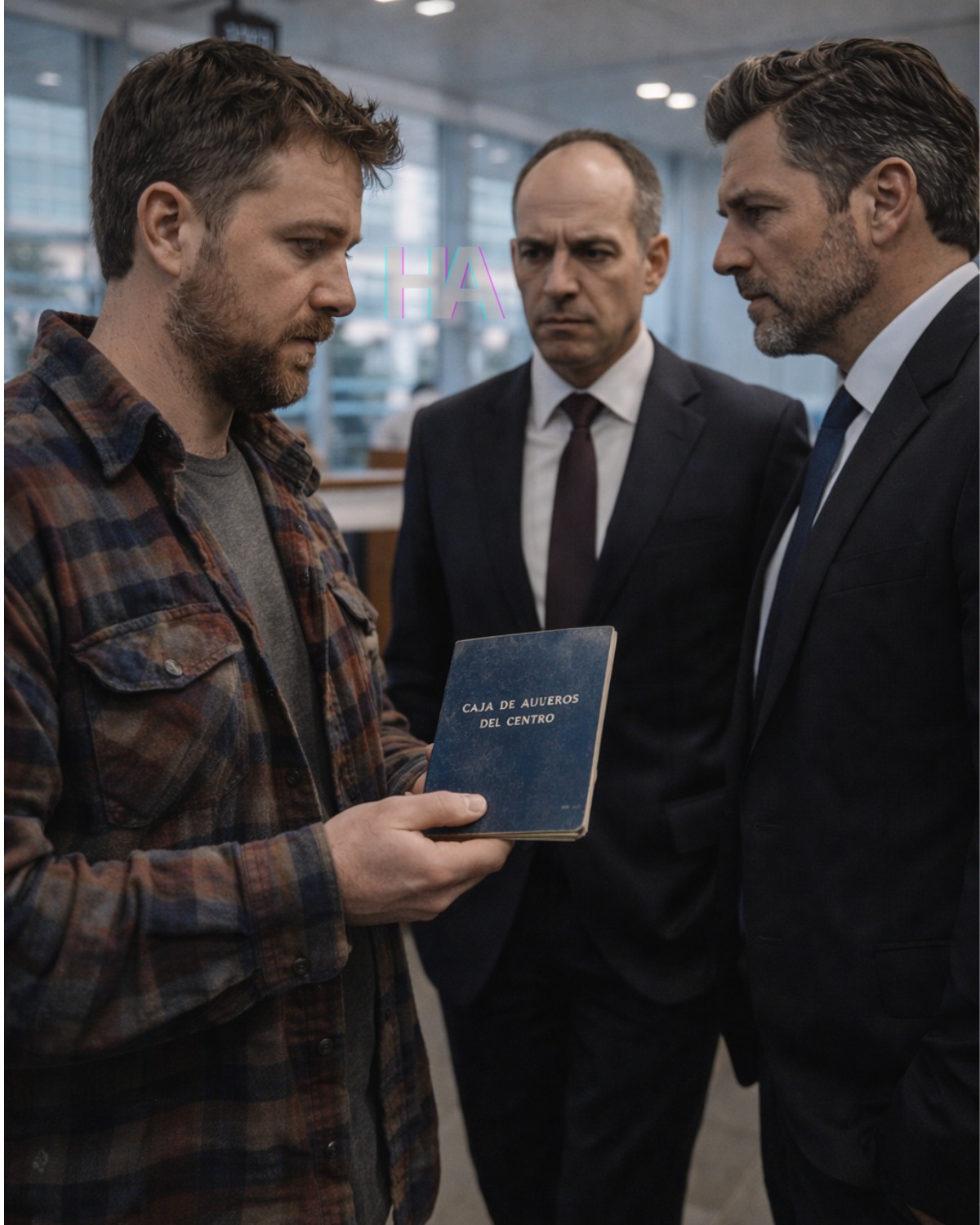
One evening, after the last truck is back and the shop has gone quiet, you take the blue passbook out of the safe in your office and turn it over in your hands.
The cover is still faded. The corners are still soft. It still looks like something that should have been dead for decades and wasn’t.
Your son walks in while you’re holding it.
He is old enough now to know what it is, at least in outline. “That Grandpa Mateo book?” he asks.
“Yeah.”
“The one everybody laughed at?”
You smile a little. “That’s the one.”
He leans against the doorframe and looks at it with the solemn curiosity children reserve for objects that existed before their own understanding of time. “Did it ever bother you?” he asks. “That they laughed?”
You think about the wedding. About your father’s hand taking it from you. About Julian’s grin. About your mother smoothing discomfort with mockery because reverence had always seemed too expensive in your family unless somebody important in a suit requested it.
Then you think about Daniel Mercer stepping out from behind the teller line. About the private office. About the envelope in your grandfather’s handwriting. About the second envelope, the one that knew the future well enough to leave instructions for pride.
“Yeah,” you say. “For a while.”
“What changed?”
You look down at the passbook again.
“I finally took it somewhere the truth still existed.”
Later that night, after Hannah and your son are asleep, you drive to the cemetery.
You don’t do it often. Your grandfather would probably think regular graveside speeches were too dramatic by half. But some days ask for witness, and this is one of them. You stand in the dark with your hands in your jacket pockets, the winter air sharp in your lungs, and tell him about the newest scholarship class, about the house, about the warehouse expansion, about your son asking questions he is finally old enough to carry.
Then you hold the blue passbook against your thigh and say the one thing that has been sitting in you since that bank morning years ago.
“You were right about later.”
The wind moves softly through the bare branches above you. No revelation follows. No cinematic sign. Just the small, steady quiet your grandfather always seemed to trust more than noise.
On the drive home, you realize that what he left you was never only money.
It was proof.
Proof that quiet things can outlast ridicule. Proof that discipline can grow in the dark where applause never reaches. Proof that the people who laugh first are often just confessing what they are too shallow to recognize. And maybe most of all, proof that being seen clearly by one good man can alter the course of an entire life.
At your wedding, your family treated that little blue passbook like a joke from a dead bank.
Five years later, a branch manager came out from behind the counter, a regional executive followed him, and the first institution anyone trusted with marble floors and expensive ties stood up straighter than your own blood ever had. But even that wasn’t the real twist.
The real twist was this:
Your grandfather had not been hiding money.
He had been hiding time. Freedom. Leverage. Dignity. A way out of inherited smallness. And he didn’t leave it to the loudest person at the table, or the one with the nicest shoes, or the son who thought ownership was the same as worth.
He left it to the one who listened.
THE END
Read more by clicking the (NEXT »») button below!