This is why appearances can be misleading. Two containers can look equally full, but still contain very different amounts of liquid depending on what is placed inside them. In this puzzle, the objects are the key variable that changes everything.
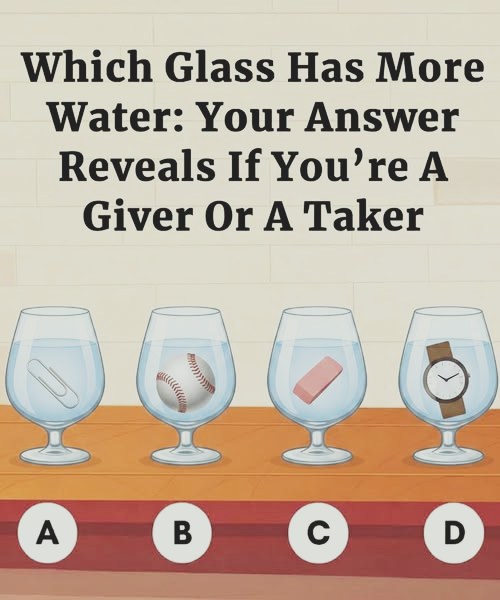
Glass B, which contains a baseball, is the most extreme example. A baseball takes up a large volume compared to the size of the glass, meaning it displaces a significant amount of water. Even though the water level looks identical to the other glasses, the actual amount of water inside is much lower.
Glass D, containing a wristwatch, also displaces a considerable amount of space. Watches are bulky compared to smaller objects and therefore reduce the volume of water more than people might expect at first glance.
Glass C, with an eraser, falls somewhere in the middle. It does not displace as much water as a baseball or watch, but it still reduces the total water volume more than very small objects.
The Correct Answer and Why It Works
The correct answer is Glass A, which contains the paperclip. The paperclip is extremely small, meaning it displaces the least amount of water among all the objects shown. Because all glasses appear equally filled to the top, the one with the smallest object inside must logically contain the greatest volume of water.
This is the key idea behind the puzzle: the visible surface level of water does not always represent the true amount of liquid inside a container. What matters is how much space is being occupied by solid objects within it.
Many people get this wrong at first because the brain relies heavily on visual shortcuts. We tend to trust what we see immediately rather than analyzing what is hidden beneath the surface. This is a natural cognitive habit known as visual assumption, where the mind fills in missing information based on appearance rather than calculation.
Why This Puzzle Confuses So Many People
Puzzles like this are designed to test more than just logic—they test perception. The human brain is incredibly fast at processing visual information, but that speed comes with shortcuts. When all four glasses look identical in fullness, the brain quickly assumes the simplest explanation: equal water levels mean equal amounts of water.
However, this puzzle introduces a hidden variable that changes everything. The objects inside each glass are not just decorations—they are part of the system. Once you account for displacement, the entire problem changes.
This is why so many people online find the puzzle surprising. It forces a shift from instinctive thinking to analytical thinking. Instead of trusting what the eyes show, you have to consider physical principles.