Slow Cooker Hobo Dinners
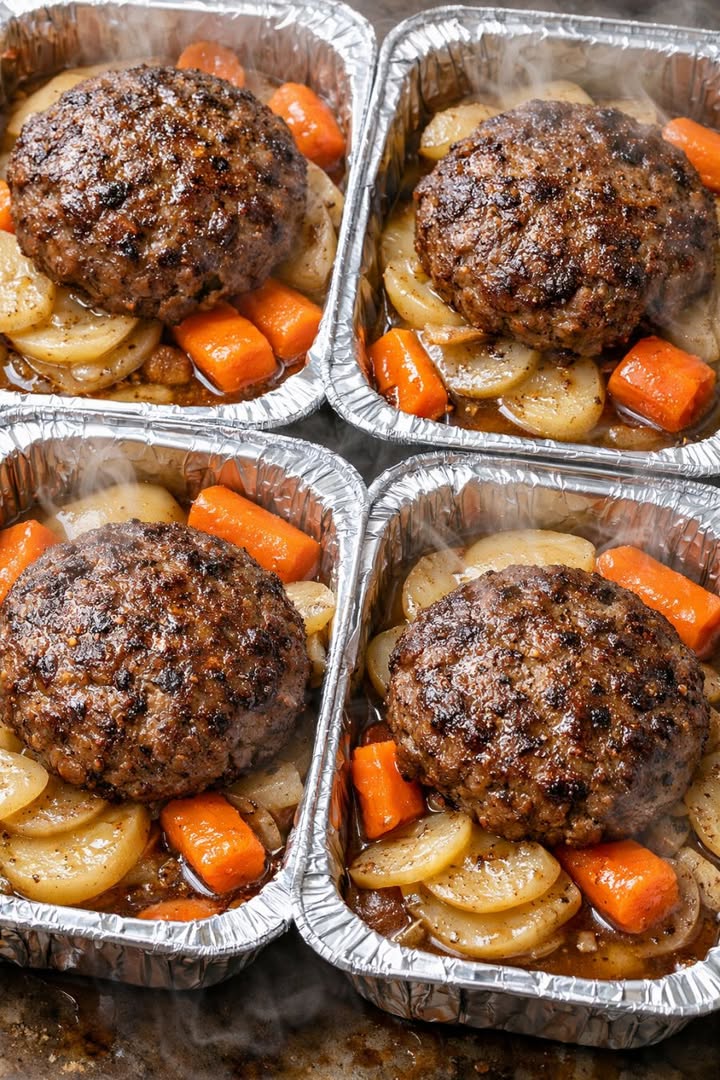
Hobo dinners — ground beef patties layered over sliced potatoes and carrots, seasoned with dry onion soup mix, wrapped or trayed in foil, and cooked until everything is tender and bathed in savory beef juices — are one of the most quietly brilliant preparations in Midwestern home cooking. The concept is campfire cooking adapted for the kitchen: each person gets their own individual portion assembled in their own foil tray, cooked in its own contained environment where the beef’s juices and the onion soup mix’s seasoning intermingle with the starch from the potatoes and the sweetness from the carrots into a cooking liquid that is the most flavorful part of the whole dish. There is something particularly satisfying about a meal that comes to the table in its own vessel, complete and self-contained, with every element having cooked together from the beginning.
The slow cooker version of this recipe applies the gentle, sustained low heat of a covered slow cooker to the same principle, producing results that are in some ways better than the campfire original: the potatoes and carrots become completely, uniformly tender rather than cooking unevenly against a direct heat source, the beef patties cook through gently without drying out, and the concentrated juices that collect in the bottom of each foil tray over six to seven hours on LOW have more depth and richness than a faster cook produces. Four ingredients, minimal prep, and the slow cooker does all the work while the day proceeds around it.
The History of Hobo Dinners
The hobo dinner or hobo stew in its foil packet form is associated with Depression-era and mid-century American outdoor cooking, where the same practical logic that made campfire cooking economical — a single heat source, minimal equipment, everything in one pot or packet — was applied to whatever affordable ingredients were available. Ground beef, potatoes, onions, and carrots were among the cheapest, most widely available ingredients throughout the mid-twentieth century, and their combination in a single sealed cooking vessel that required no additional equipment beyond a heat source made them the natural choice for this preparation.
The dry onion soup mix, which became the standard seasoning for this type of dish from the 1950s onward, was the convenience ingredient that elevated the practical to the genuinely flavorful. A single packet contains the concentrated flavors of dehydrated onion, beef flavoring, salt, and other savory seasonings that, when combined with the beef’s rendered fat and the moisture released by the vegetables in the sealed foil environment, produce a braising liquid of remarkable depth for something assembled in minutes from pantry staples. It is one of the more inspired convenience ingredient pairings in American home cooking.
Why the Foil Tray Method Works
The foil tray approach for this recipe — rather than completely sealed foil packets — is a meaningful technique distinction that produces a different result from fully wrapped hobo packets. A sealed packet traps all steam inside and cooks the contents entirely in their own moisture, which produces very tender vegetables and moist meat but can make the cooking liquid thin and watery from the accumulated steam. An open-top foil tray set inside the covered slow cooker achieves the best of both approaches: the slow cooker’s lid retains the steam that comes from the heated liquid in the trays, cooking the tops of the beef patties and the exposed vegetables from above; the open tray allows some steam to escape so the cooking liquid concentrates rather than diluting; and the individual tray format keeps each person’s portion self-contained, preventing the juices from one portion from mixing with another and allowing each serving to be lifted from the slow cooker and placed directly on a plate.
Why You’ll Love This Recipe
Four ingredients, ten minutes of preparation, and six to seven hours of completely unattended cooking produce four individual complete dinners — protein, starch, and vegetable — each in its own serving vessel, ready to go directly from the slow cooker to the plate. The individual format makes serving effortless and particularly appealing for households where people eat at slightly different times or have different portion preferences. The cooking juices that pool in the bottom of each tray over the long, slow cook are the most flavorful element of the dish and should be spooned generously over the beef and vegetables at the table. The recipe is easily scaled — add more trays in a larger slow cooker — and adapts readily to whatever root vegetables are on hand.
Ingredient Notes
Lean ground beef — one and a half pounds, divided into four equal patties — is the protein. A moderate fat content — 85 percent lean — is the best choice for this preparation: it provides enough fat to keep the patties moist during the six to seven-hour LOW cook and to enrich the cooking juices that collect in the tray, without producing so much rendered fat that the tray becomes greasy. Very lean ground beef (90 to 93 percent) produces drier patties with less flavorful juices; fatty ground beef (80 percent) produces more abundant but greasier juices. Season the beef with the onion soup mix before shaping — working the seasoning through the meat while it’s still in loose form ensures even distribution through every patty. Mix just enough to combine the seasoning through the meat; overmixing develops the myosin proteins in the beef in a way that produces dense, compacted patties.
Russet potatoes — four medium, peeled and thinly sliced — form the base layer of each foil tray. Russet potatoes are the appropriate choice for this application: their high starch content absorbs the beef and onion soup juices as they cook, becoming creamy and flavorful in a way that waxy potatoes don’t achieve. Thin slices — an eighth to a quarter inch — are essential: thicker slices may not fully cook through in the same time as the beef patties, producing a finished tray where the beef is perfectly done but the potato center still has firmness. A mandoline produces the most consistent thin slices; a sharp knife with careful technique works equally well. Yukon Gold potatoes can be substituted for a creamier, slightly sweeter result with less of the starchy absorption quality of russets.
Carrots — three large, peeled and thinly sliced — are layered over the potatoes before the beef patty is placed on top. Carrots add natural sweetness that balances the saltiness of the onion soup mix, and their slight firmness even when cooked provides textural contrast against the tender potatoes. Thin coins — an eighth of an inch — cook through reliably in the same time as the potato slices. Thicker cuts may remain slightly firm; if you prefer a very tender carrot, cut slightly thinner than the potato slices.
Dry onion soup mix — one 1-ounce packet — is the seasoning for the entire dish, distributed through the four beef patties. The packet contains concentrated dehydrated onion, beef flavoring, salt, and savory seasoning that seasons the beef throughout and dissolves into the cooking juices during the long cook, producing the deeply flavored brown braising liquid that makes this dish so satisfying. One full packet for four patties is the correct amount — any less produces underseasoned patties; any more can make the dish too salty. Do not add additional salt until tasting the finished dish, as the packet provides substantial salt.
Ingredients
1½ lbs lean ground beef (85% lean recommended)
4 medium russet potatoes, peeled and thinly sliced (⅛ to ¼ inch)
3 large carrots, peeled and thinly sliced into coins
1 packet (1 oz) dry onion soup mix
You will also need: heavy-duty aluminum foil (or doubled regular foil), cut into four 12×18-inch sheets.
Read more by clicking the (NEXT »») button below!